
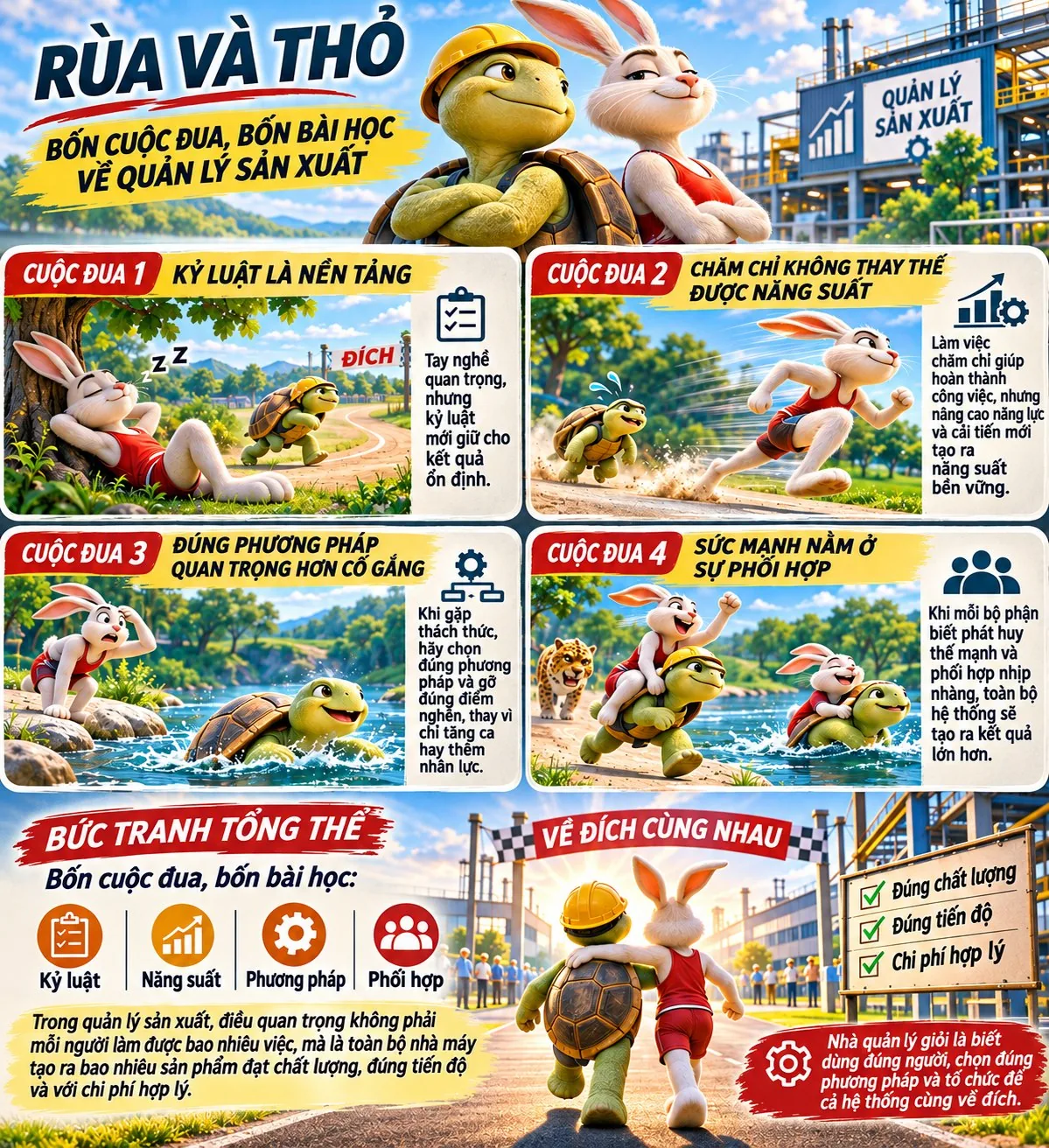
Chúng ta thường kể chuyện Rùa và Thỏ để ca ngợi sự kiên trì. Nhưng nếu cuộc đua được tổ chức thêm ba lần nữa, liệu Rùa có tiếp tục chiến thắng?
Câu chuyện mở rộng này gợi ra bốn bài học đáng suy ngẫm về quản lý sản xuất.
1. CUỘC ĐUA THỨ NHẤT – KỶ LUẬT LÀ NỀN TẢNG
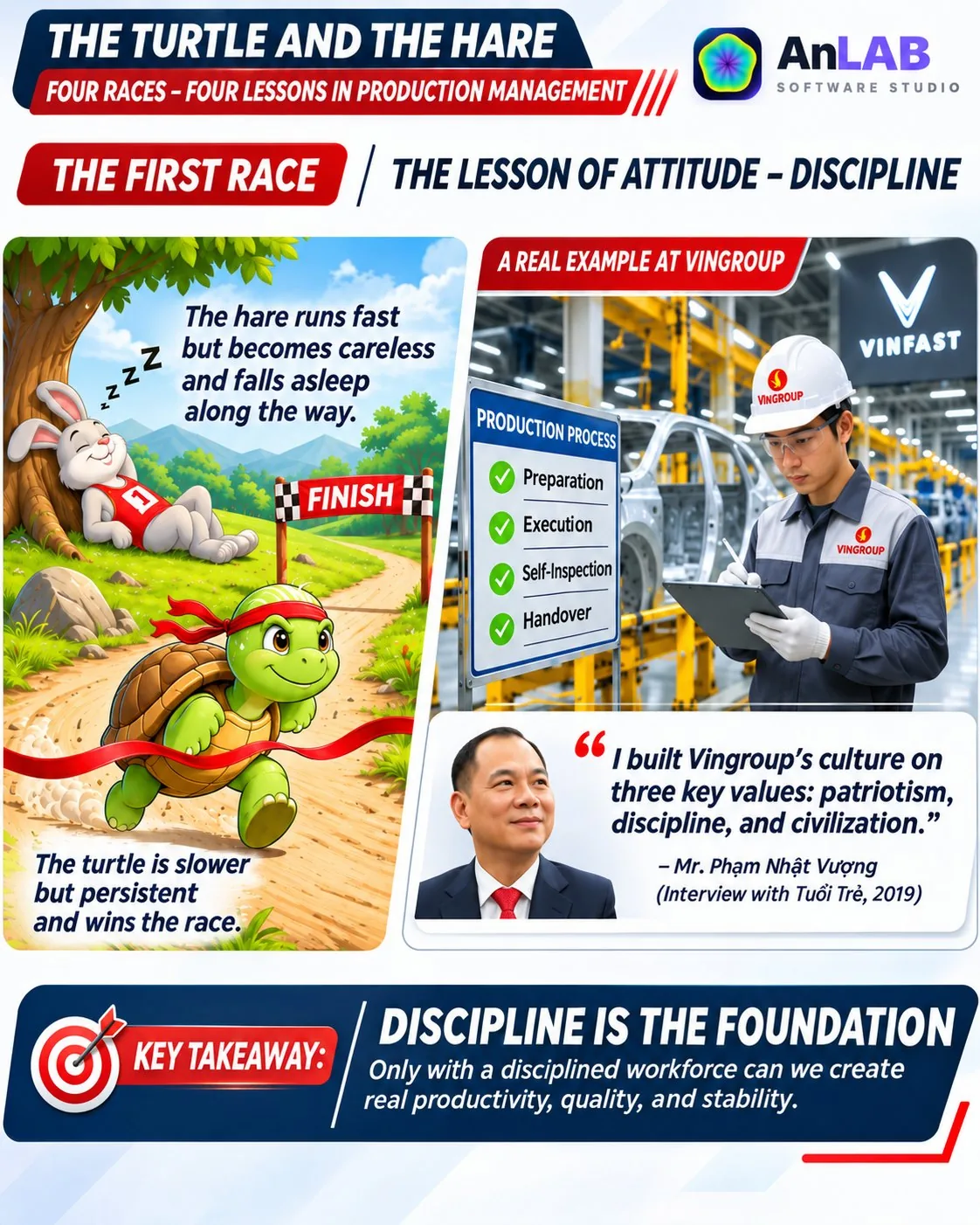
Thỏ nhanh nhưng chủ quan, giữa đường nằm ngủ. Rùa chậm nhưng kiên trì và giành chiến thắng.
Nhìn vào Vingroup: Trong cuộc phỏng vấn với báo Tuổi Trẻ năm 2019, ông Phạm Nhật Vượng từng nói:
Kỷ luật được Vingroup đặt vào nền tảng văn hóa quản trị, thể hiện qua tiêu chuẩn công việc, đánh giá và trách nhiệm thực hiện.
Trong sản xuất: Một thợ hàn giỏi nhưng bỏ qua quy trình có thể gây ra sai lỗi khiến cả dây chuyền phải sửa chữa, chậm tiến độ. Tay nghề quyết định khả năng làm việc, nhưng kỷ luật quyết định sự ổn định của kết quả.

2. CUỘC ĐUA THỨ HAI – CHĂM CHỈ KHÔNG THAY THẾ ĐƯỢC NĂNG SUẤT
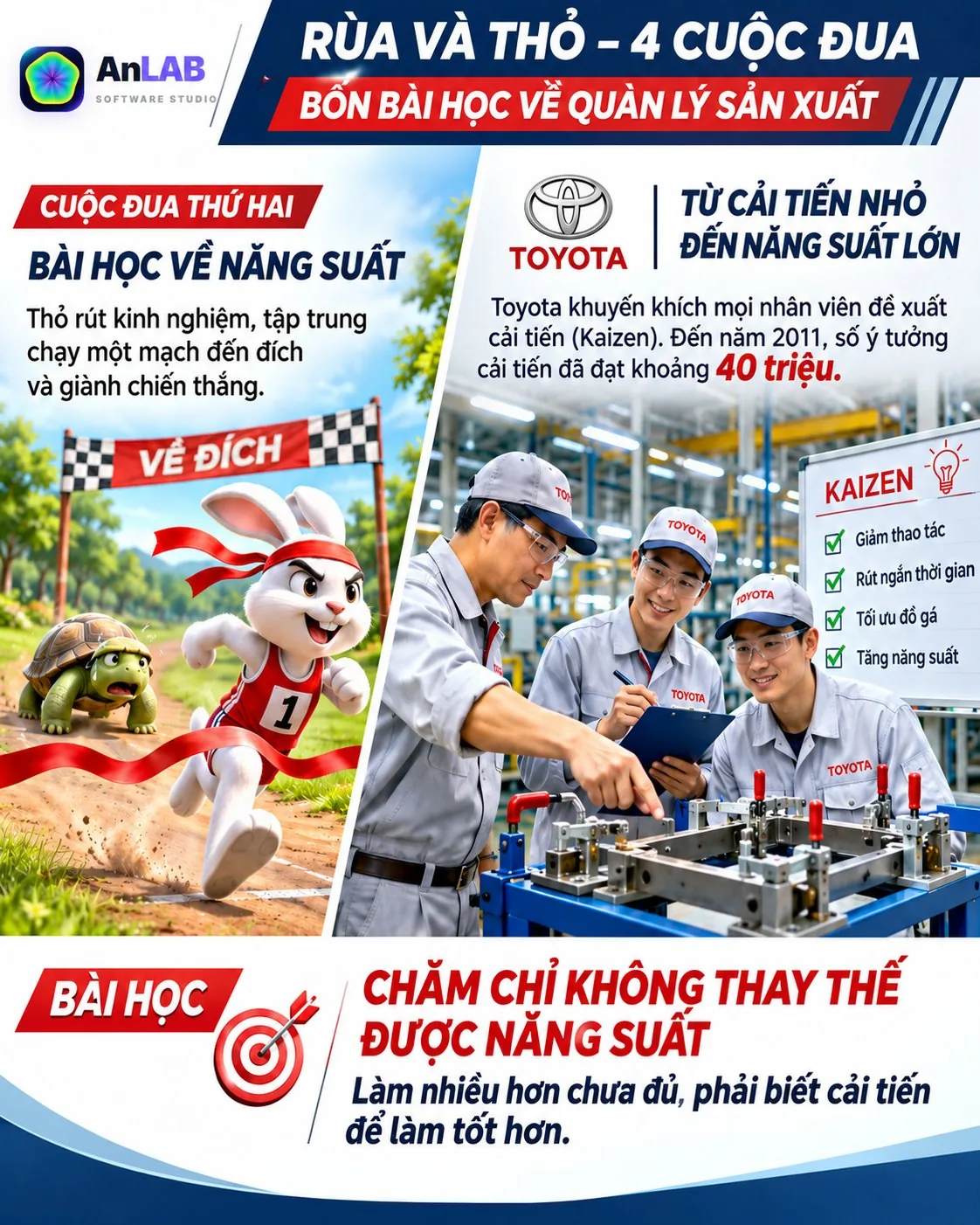
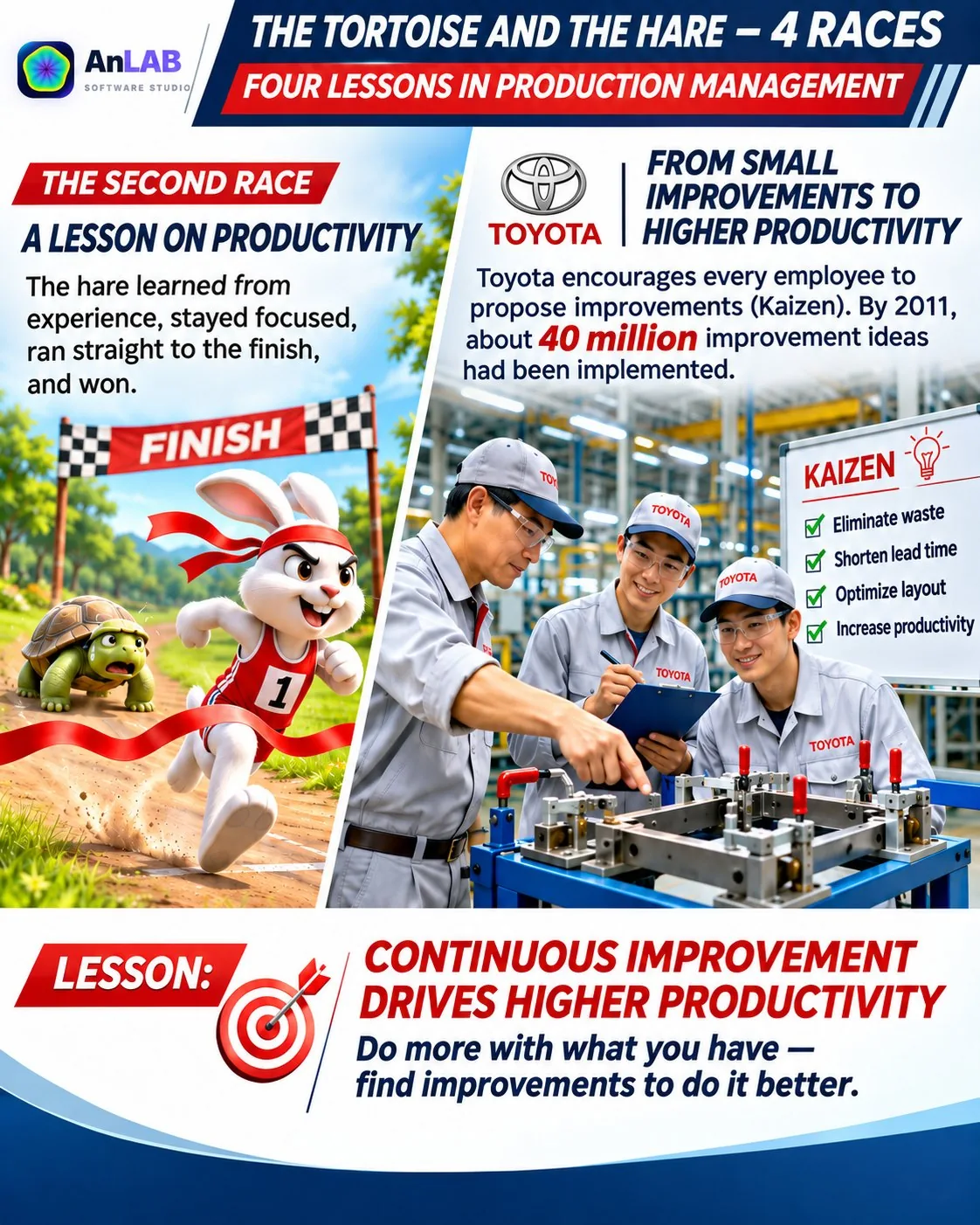
Thỏ rút kinh nghiệm, không ngủ nữa mà chạy thẳng đến đích. Lần này Rùa dù cố gắng đến đâu cũng không thể thắng.
Nhìn vào Toyota: Từ năm 1951, Toyota đã triển khai hệ thống khuyến khích nhân viên đề xuất cải tiến. Đến năm 2011, số ý tưởng tích lũy đạt 40 triệu. Thay vì chỉ yêu cầu công nhân làm việc nhiều hơn, Toyota khuyến khích họ tìm cách làm tốt hơn.
Trong sản xuất: Một tổ lắp ráp làm thêm hai giờ mỗi ngày chưa chắc hiệu quả bằng tổ biết cải tiến đồ gá, giảm thao tác thừa và hạn chế sửa lỗi.
Chăm chỉ giúp hoàn thành công việc. Nâng cao năng lực và cải tiến mới giúp tăng năng suất bền vững.
3. CUỘC ĐUA THỨ BA – ĐÚNG PHƯƠNG PHÁP QUAN TRỌNG HƠN CỐ GẮNG
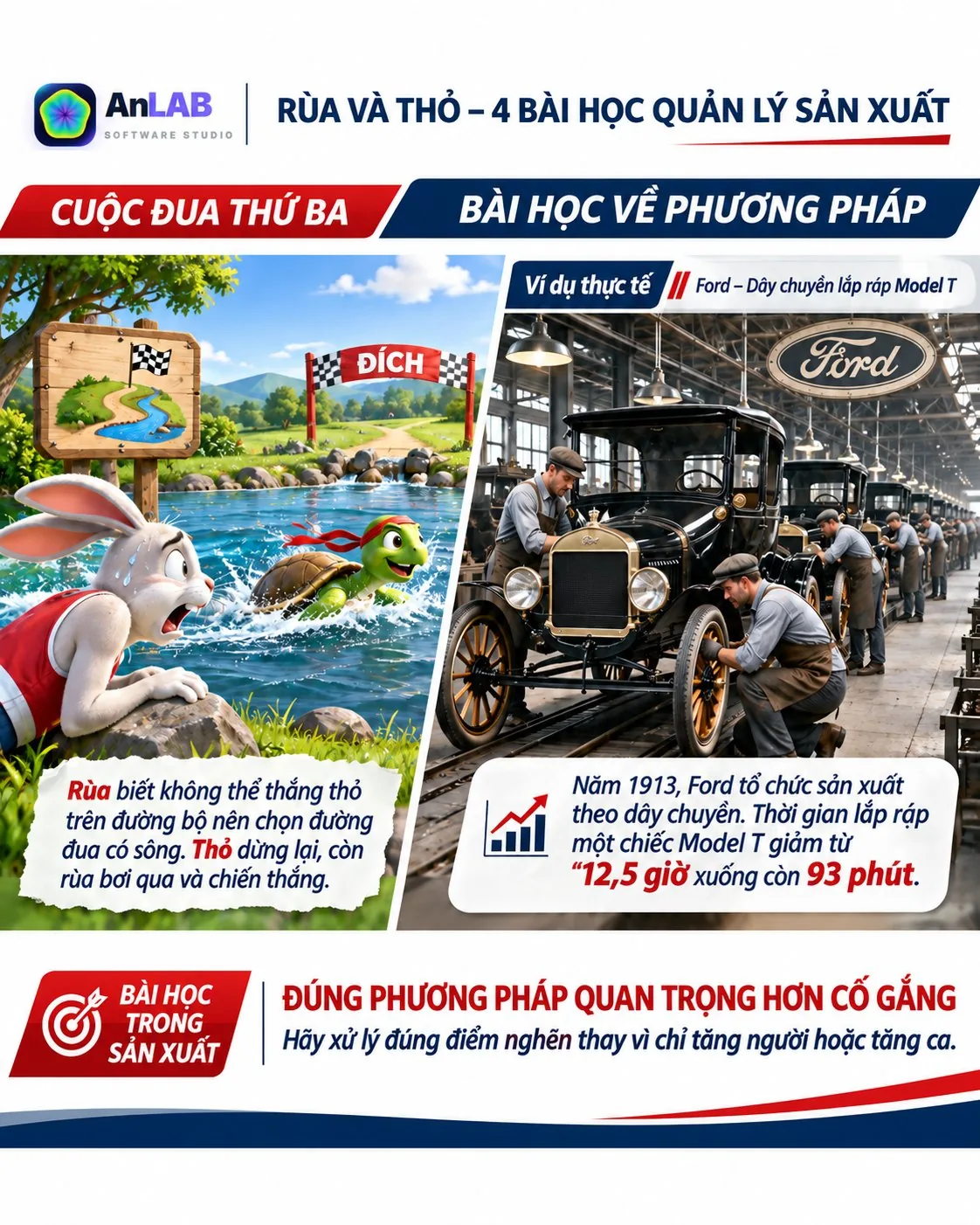
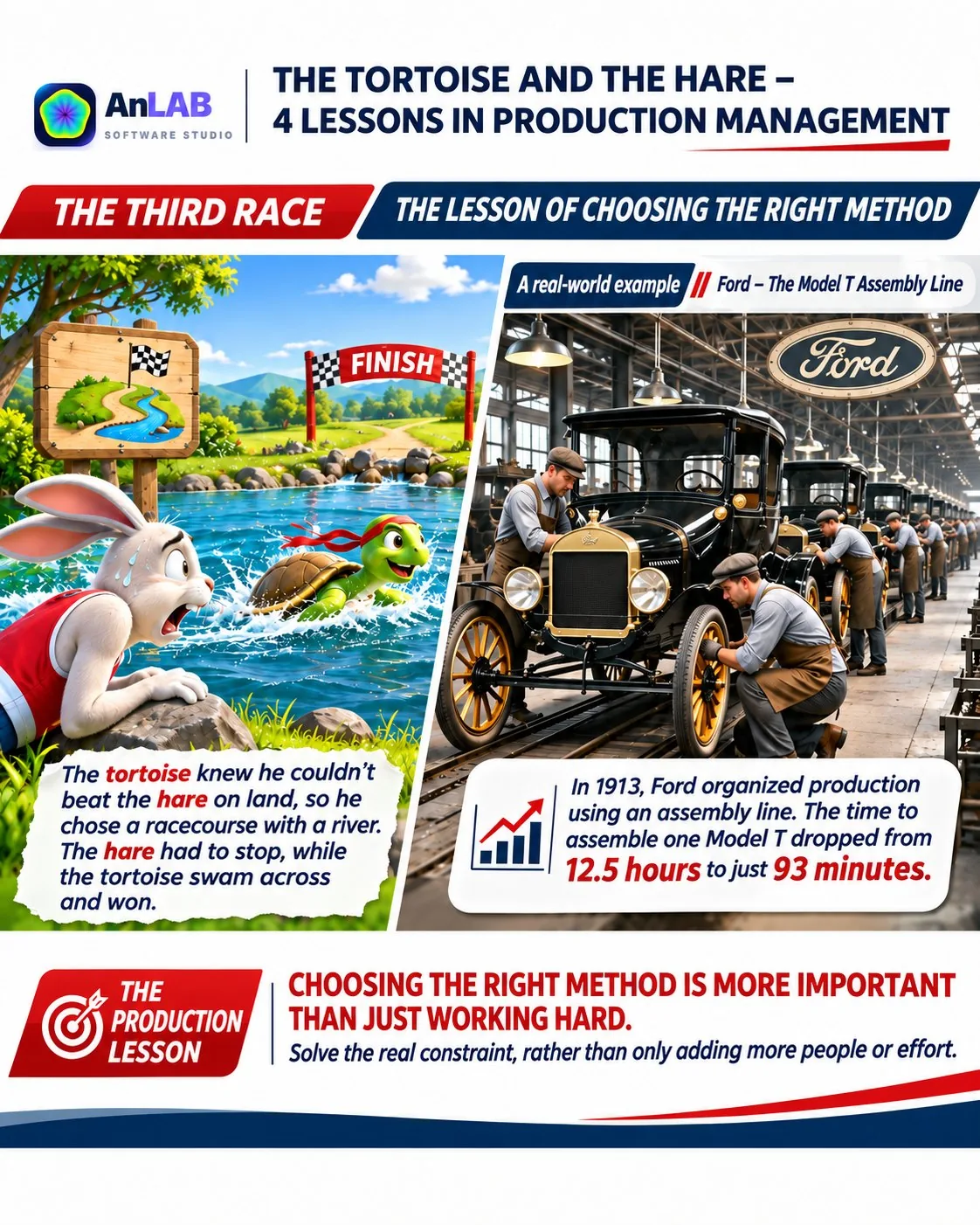
Biết không thể thắng Thỏ trên đường bộ, Rùa chọn đường đua có sông. Thỏ dù chạy nhanh vẫn phải dừng lại, còn Rùa bơi qua và chiến thắng.
Nhìn vào Ford: Năm 1913, Henry Ford đưa dây chuyền lắp ráp chuyển động vào sản xuất ô tô. Đến đầu năm 1914, thời gian lắp ráp một chiếc Model T giảm từ khoảng 12,5 giờ xuống còn 93 phút.
Ford không đơn thuần yêu cầu công nhân làm nhanh hơn. Ông cùng đội ngũ thay đổi cách tổ chức sản xuất.
Trong nhà máy: Khi sản lượng thấp, tăng ca hay bổ sung nhân lực không phải lúc nào cũng đúng. Nếu điểm nghẽn nằm ở thiết bị, cấp vật tư hoặc trình tự gia công, phải giải quyết từ chính những khâu đó.
Một phương pháp sai không thể trở nên hiệu quả chỉ bằng cách làm việc vất vả hơn.
4. CUỘC ĐUA THỨ TƯ – SỨC MẠNH NẰM Ở SỰ PHỐI HỢP
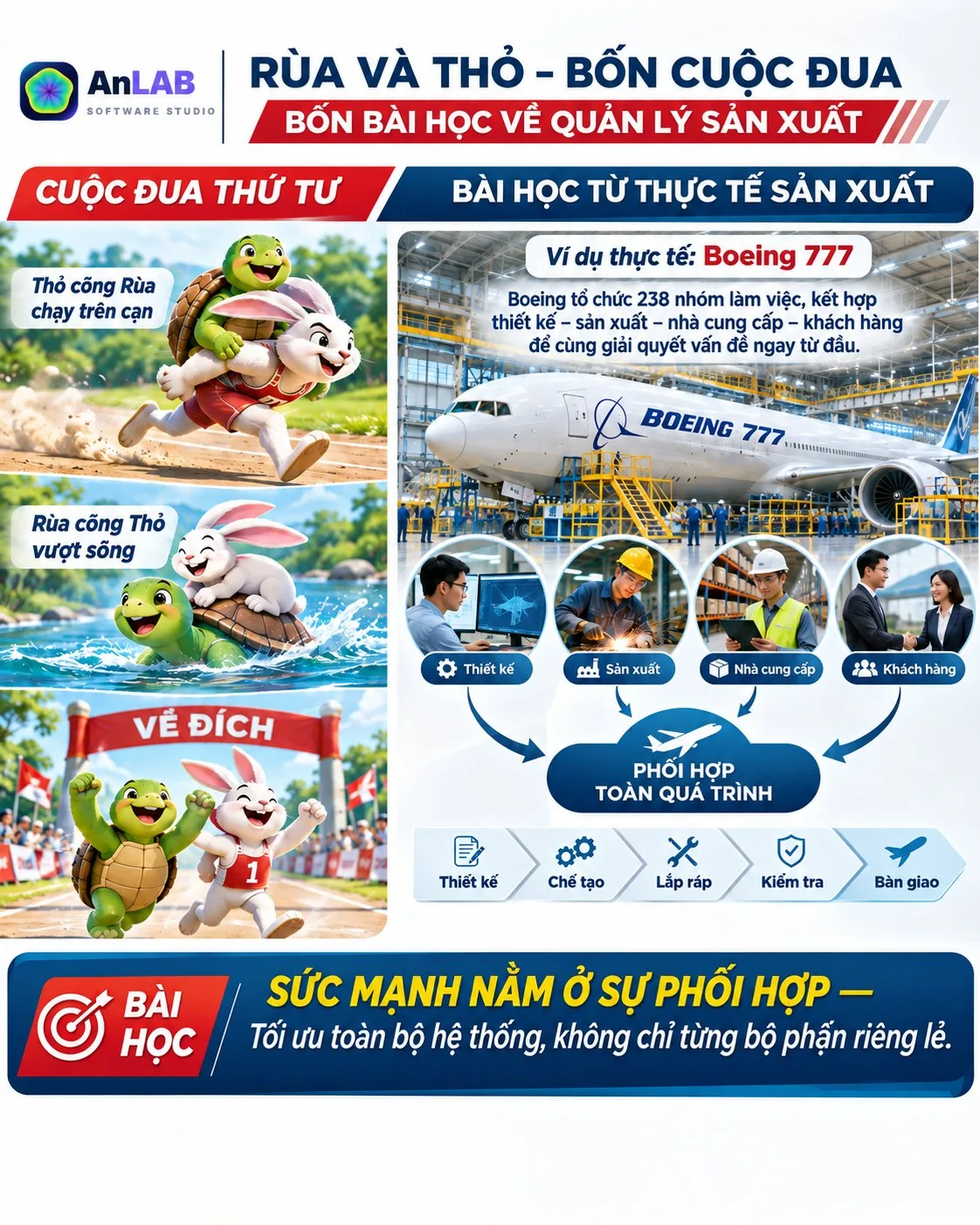
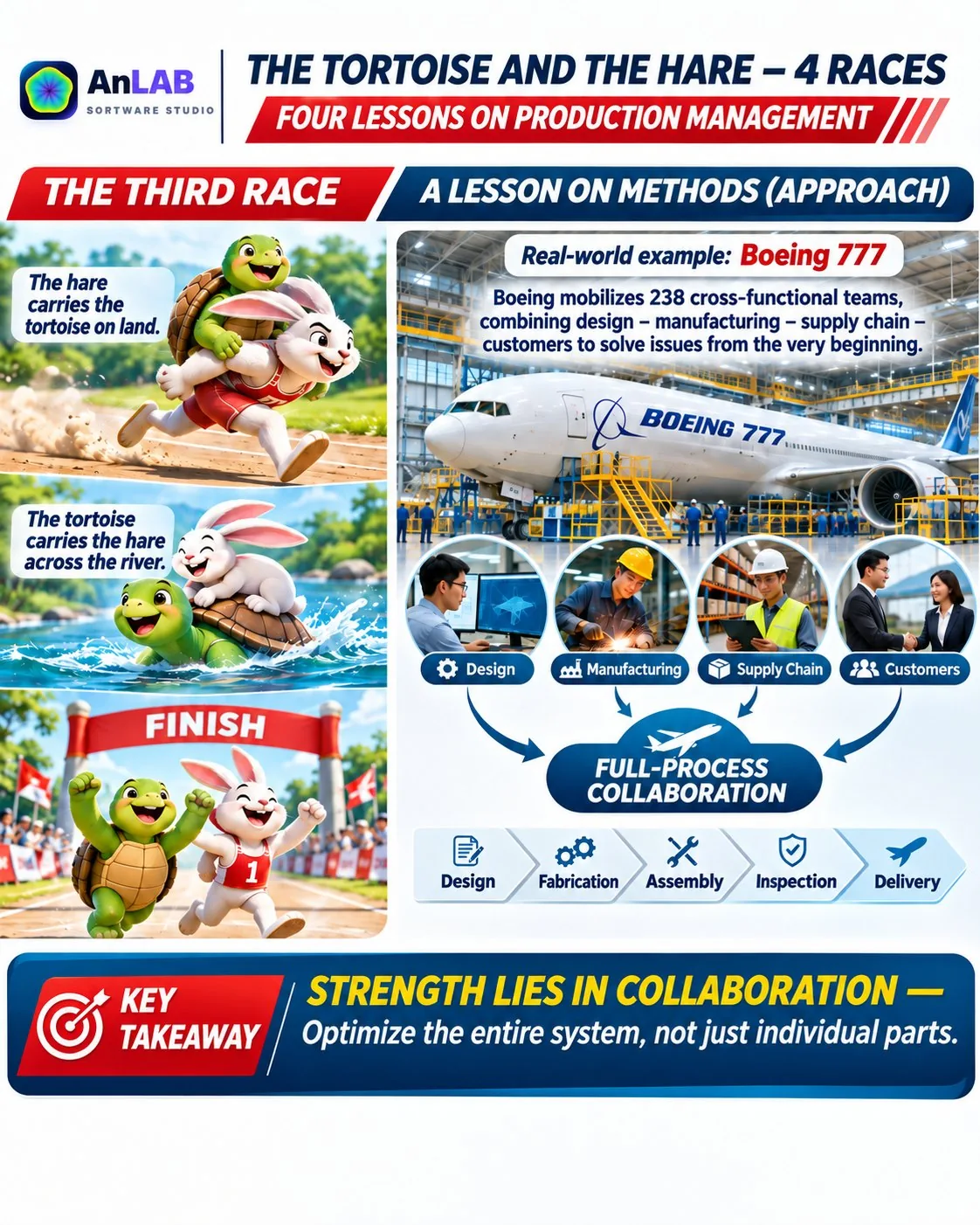
Báo Nepa từ châu Phi đến thách đấu. Lần này, Thỏ cõng Rùa chạy trên cạn, Rùa cõng Thỏ vượt sông. Nhờ phối hợp thế mạnh, cả hai cùng chiến thắng.
Nhìn vào Boeing 777: Khi phát triển dòng máy bay này, Boeing tổ chức 238 nhóm thiết kế – chế tạo, kết hợp kỹ sư thiết kế, sản xuất, nhà cung cấp và khách hàng. Họ cùng giải quyết vấn đề ngay từ giai đoạn thiết kế, thay vì làm tuần tự rồi mới phát hiện những điểm không phù hợp khi lắp ráp.
Trong sản xuất kết cấu thép: Bộ phận cắt đạt sản lượng nhưng cấp thiếu chi tiết đồng bộ, lắp ráp làm nhanh nhưng hàn phải chờ, sản xuất hoàn thành nhiều nhưng QA/QC phát hiện lỗi phải sửa hàng loạt — cuối cùng nhà máy vẫn chậm tiến độ.
Một bộ phận đạt chỉ tiêu không có nghĩa cả nhà máy hoạt động hiệu quả.
LỜI BÀN
Bốn cuộc đua, bốn bài học: Kỷ luật – Năng suất – Phương pháp – Phối hợp.
Một người giỏi có thể thất bại vì chủ quan. Một người chăm chỉ có thể tụt hậu vì năng suất thấp. Một tập thể nỗ lực vẫn có thể thất bại vì chọn sai cách làm. Và nhiều bộ phận giỏi chưa chắc tạo thành một nhà máy mạnh nếu thiếu phối hợp.
Trong quản lý sản xuất, điều đáng quan tâm không phải mỗi người làm được bao nhiêu việc, mà là cuối cùng cả nhà máy tạo ra được bao nhiêu sản phẩm đạt chất lượng, đúng tiến độ và với chi phí hợp lý.
Người quản lý giỏi không phải là bắt Rùa chạy nhanh như Thỏ, hay bắt Thỏ học bơi như Rùa, mà là biết dùng đúng người, chọn đúng phương pháp và tổ chức để cả hệ thống cùng về đích.
We often tell the story of the Tortoise and the Hare to celebrate perseverance. But what if they raced three more times? Would the Tortoise keep winning?
This extended version of the classic fable offers four thought-provoking lessons in production management.
1. THE FIRST RACE – DISCIPLINE IS THE FOUNDATION
The Hare is fast but overconfident. Halfway through the race, he stops to take a nap. The Tortoise is slow but persistent, and eventually wins.
The Vingroup Example: In a 2019 interview with Tuổi Trẻ newspaper, Phạm Nhật Vượng, Chairman of Vingroup, stated:
Discipline is a cornerstone of Vingroup's management culture, reflected in its work standards, performance evaluations, and accountability.
On the Production Floor: A highly skilled welder who ignores established procedures can cause defects that require extensive rework and delay the entire production line.
Technical skills determine what a person is capable of doing, but discipline determines how consistently they deliver results.
2. THE SECOND RACE – HARD WORK CANNOT REPLACE PRODUCTIVITY
The Hare learns from his mistake. This time, he runs straight to the finish line without stopping. No matter how hard the Tortoise tries, he cannot win.
The Toyota Example: In 1951, Toyota introduced a system encouraging employees to suggest improvements. By 2011, the cumulative number of suggestions had reached 40 million.
Rather than simply asking workers to work harder, Toyota encouraged them to find better ways of working.
On the Production Floor: An assembly team working two extra hours every day may be less productive than another team that improves its jigs and fixtures, eliminates unnecessary movements, and reduces rework.
Hard work helps get the job done. Improving capabilities and continuously refining processes creates sustainable productivity growth.
3. THE THIRD RACE – THE RIGHT METHOD MATTERS MORE THAN EFFORT ALONE
Realizing he cannot outrun the Hare on land, the Tortoise chooses a racecourse that crosses a river.
The Hare races ahead but cannot cross the water. The Tortoise swims across and wins.
The Ford Example: In 1913, Henry Ford introduced the moving assembly line into automobile manufacturing. By early 1914, the assembly time for a Model T had dropped from approximately 12.5 hours to just 93 minutes.
Ford and his team did not simply demand that workers move faster. They fundamentally changed how production was organized.
In the Factory: When output is low, adding overtime or hiring more workers is not always the right solution.
If the bottleneck lies in equipment capacity, material supply, or production sequencing, those constraints must be addressed directly.
A flawed method does not become effective simply because people work harder.
4. THE FOURTH RACE – STRENGTH COMES FROM COLLABORATION
A leopard named Nepa arrives from Africa and challenges them to another race.
This time, the Hare carries the Tortoise across the land, while the Tortoise carries the Hare across the river.
By combining their strengths, they win together.
The Boeing 777 Example: During the development of the Boeing 777, Boeing organized 238 design-build teams, bringing together design engineers, manufacturing specialists, suppliers, and customers.
Instead of working in isolated, sequential stages and discovering problems during final assembly, these teams collaborated to identify and resolve issues early in the design process.
In Steel Structure Manufacturing: The cutting department may meet its production targets but fail to deliver complete sets of components. The assembly team may work quickly but leave the welding department waiting. Production may achieve high output, only for QA/QC to discover widespread defects requiring extensive rework.
In the end, the entire factory still falls behind schedule.
One department meeting its targets does not necessarily mean the factory is performing efficiently.
FINAL REFLECTION
Four races. Four lessons: Discipline – Productivity – Method – Collaboration.
A talented individual can fail through overconfidence.
A hardworking employee can fall behind because of low productivity.
A determined team can still fail by choosing the wrong approach.
And several high-performing departments do not necessarily make a strong factory if they fail to work together.
In production management, the real measure of success is not how much work each individual completes, but how many quality products the entire factory delivers, on time and at a reasonable cost.
A great manager does not try to make the Tortoise run as fast as the Hare or force the Hare to swim like the Tortoise.
Great management means putting the right people in the right roles, choosing the right methods, and organizing the entire system so that everyone crosses the finish line together.